
AC09 Cat-M1 TY
Use this page with AI
Explore with your favorite AI
 ChatGPT
  Claude
 Gemini & other AI
Copy this page’s context into your AI to explore how it works and what you can build.
 Open Gemini
 Copy the prompt, then paste it into Gemini’s message box.
View prompt
Table of contents
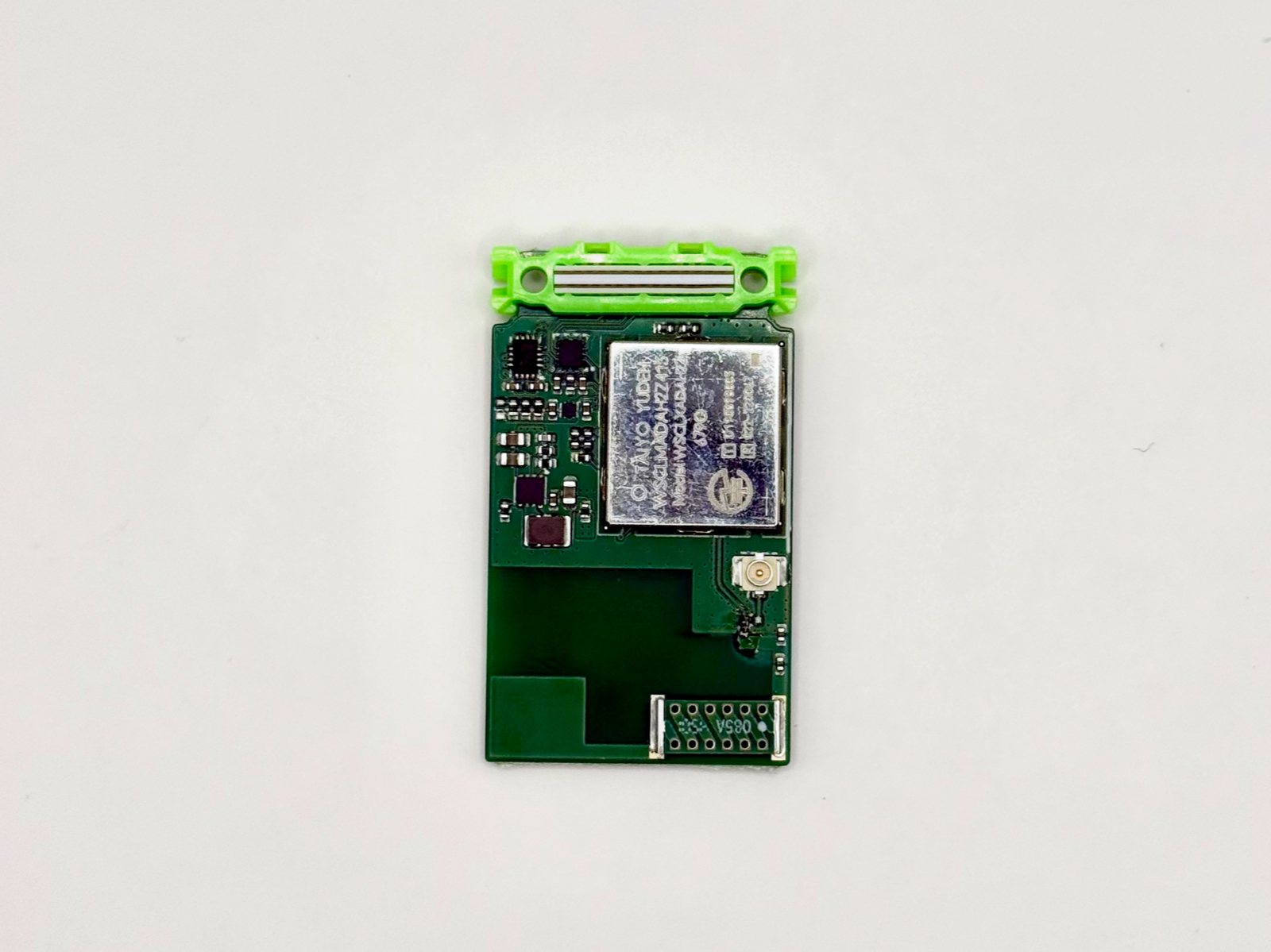
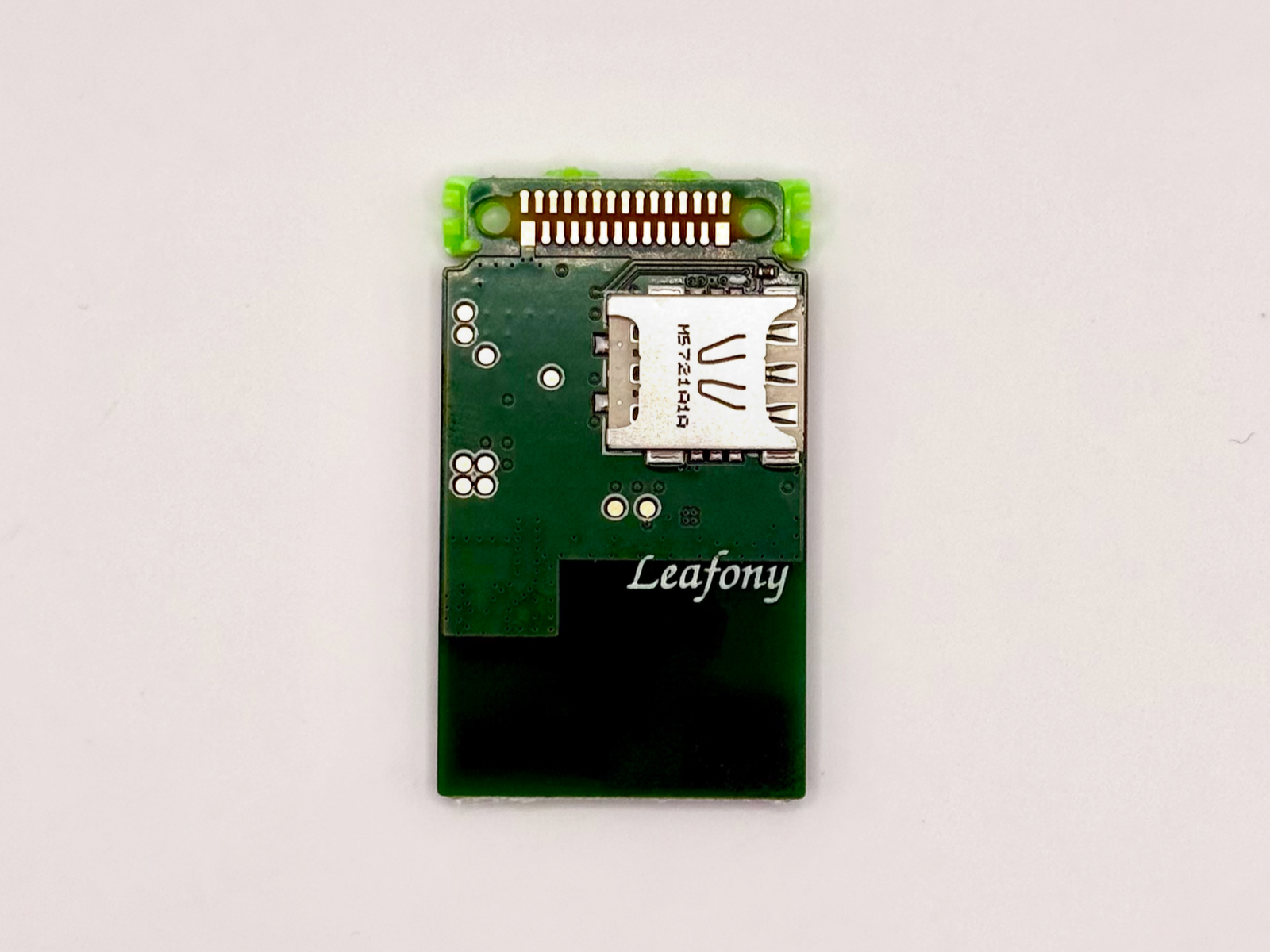
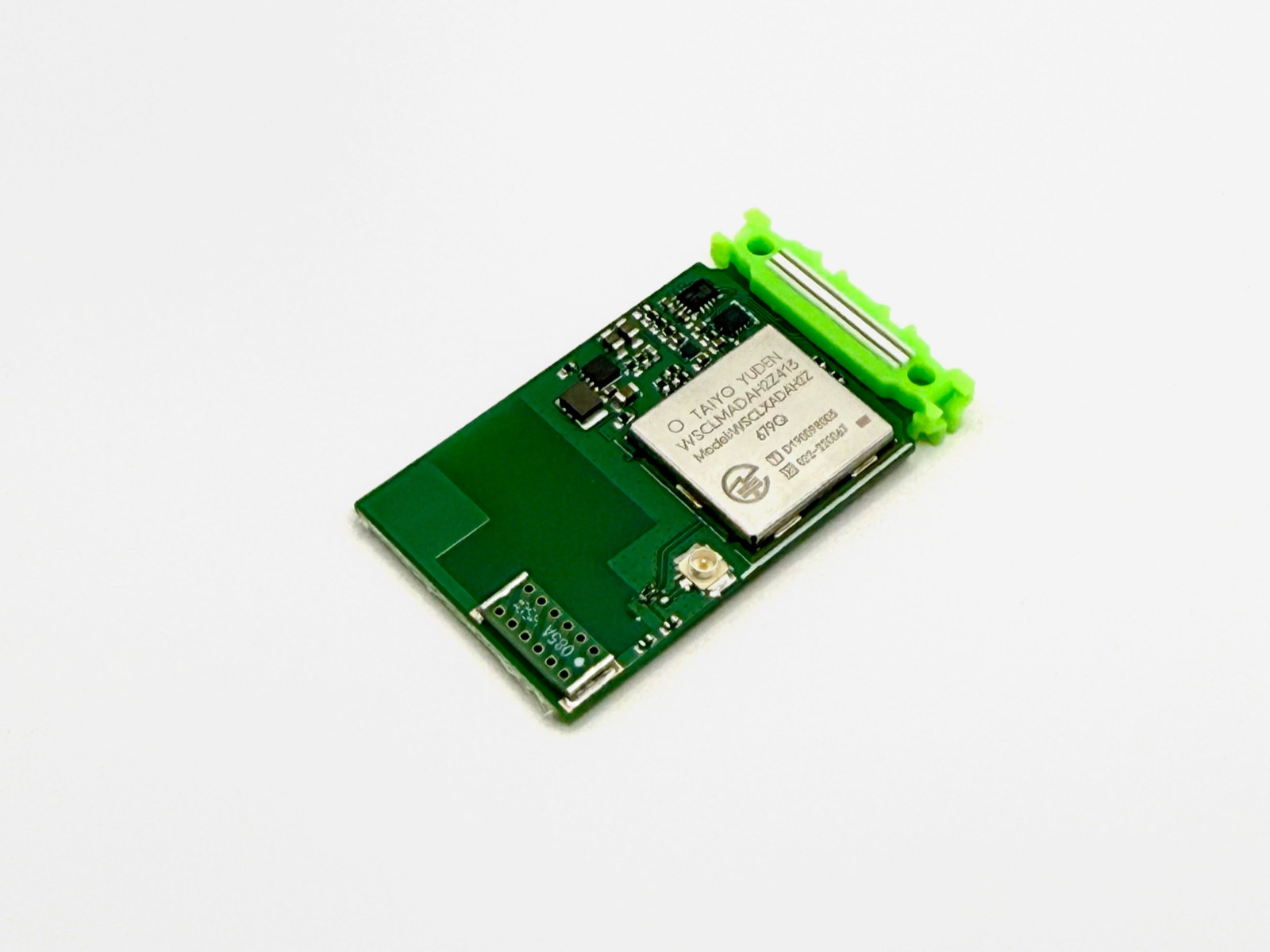
These photos show the AC09 board. The front side has the Cellular LPWA Cat-M1 module and external antenna connector; the back side has the nanoSIM slot.
Features
This Cellular LPWA Cat-M1 leaf is intended to provide cellular data communication for IoT devices when combined with a processor leaf. The Google Sheets example for AP03 + AI01 includes SIM and endpoint settings. Distinguish the example requirements from product-wide operator support and guaranteed operation.
AC09 Cat-M1 TY uses a Taiyo Yuden WSCLxADAH2Z-series cellular LPWA module.
- Communicates with the module over UART. An I2C I/O expander controls the power-button, shutdown and wakeup signals.
- Includes a nanoSIM slot, an onboard chip antenna and a U.FL connector for an external antenna.
- The module supports low-power operation with eDRX and PSM. See Taiyo Yuden’s product information (Japanese) for details.
Specifications
| Item | Description |
|---|---|
| Cellular LPWA Cat-M1 module | Taiyo Yuden WSCLxADAH2Z series |
| Communication technology | Cellular LPWA Cat-M1 |
| Power input | Leafony Bus 3.3V terminal (pin 1) |
| Host interfaces | UART (TX/RX, RTS/CTS), I2C (control) |
| UART level shifter | TXB0104RUTR (3.3V / 1.8V) |
| I/O expander | PCAL6408AHKX |
| I2C address | 0x21 (7-bit notation) |
| SIM card | nanoSIM (Molex 1042240820 slot) |
| Onboard antenna | STAF 1019-085A |
| External antenna connector | Hirose Electric U.FL-R-SMT-1(10) |
| Board dimensions | 23 × 38.7 mm (design dimensions, excluding component height) |
Product specifications, including the exact module part number, the full range of supported bands and operators, and current consumption, will be announced once confirmed. The related example describes 1NCE and SORACOM settings; it does not guarantee operation with every SIM, region or leaf configuration.
Power and control
The Leafony Bus 3.3V terminal supplies the module’s VBAT input. An onboard TPS61021ADSGT generates the RF power supply (VBAT_FEM), and a TLV71718PDQNT generates the 1.8V signal-circuit supply (VDDIO).
The module’s power state is controlled through the I/O expander. The published sample uses AV06 as a battery-powered configuration example. Also see the power-supply Q&A. Measured peak current and test results for specific battery and leaf configurations will be announced after verification.
Pin assignment
The following table lists the main Leafony Bus signals used by AC09. UART directions are shown from the processor leaf’s perspective.
| Pin | Leafony Bus signal | AC09 connection or function |
|---|---|---|
| 1 | 3.3V | Power input (VBAT) |
| 5 | RESET | I/O expander reset |
| 7 | D6 | UART input: receives the module’s RTS signal (processor CTS) |
| 11 | D8 | UART transmit: connects to the module’s RX |
| 13 | D9 | UART receive: input from the module’s TX |
| 22 | D2 | I/O expander interrupt output (INT) |
| 23 | SDA | I2C data |
| 25 | SCL | I2C clock |
| 26 | D4 | UART output: sends to the module’s CTS (processor RTS) |
I2C address
The I/O expander address is 0x21. AC08 Mary and AC04 King M use the same address, so connecting these leaves to the same I2C bus causes an address conflict. Check the I2C address map when combining leaves.
Antennas
The board is designed to select either the onboard chip antenna (ANT1) or the external antenna U.FL connector (CN3) through the JP1 connection.
| JP1 connection | Antenna used |
|---|---|
| 1–2 | Onboard chip antenna (STAF 1019-085A) |
| 2–3 | External antenna connected to CN3 |
Supported antennas and certification conditions will be announced once confirmed. Documents about antennas covered by the module’s certification are available under “Reference アンテナ一覧” on Taiyo Yuden’s product page (Japanese). User registration is required.
Development environment and samples
The PlatformIO project in the reference repository contains development code using the AP03 STM32 MCU and the Arduino framework.
This reference project still contains AC08 references and a dependency on LteLeafV4. For AC09 connections, receiver setup and troubleshooting, see the Google Sheets example below. Check the target configuration and required software for each example.
For AT command specifications, see the “AT command manual (Light Version)” on Taiyo Yuden’s product page (Japanese). User registration is required.
Related samples
- Save temperature and humidity data to Google Sheets with AC09 Cat-M1 TY: A sample for sending temperature and humidity data measured by the 4-Sensors leaf over Cellular LPWA Cat-M1 every 10 minutes and recording it in Google Sheets.
Cat-M1 Kit development preparation explains the differences for AP03B + AI05. Firmware for AP03 + AI01 cannot be used unchanged with that kit.
Documents
The design and development repository is currently private. Access to the following GitHub documents requires signing a separate non-disclosure agreement (NDA). Please contact us (Japanese) for details.
- AC09 design and development repository
- KiCad design data (schematics and board)
- Schematic (PDF included in the repository)
- Bill of materials (manufacturing BOM)
- Taiyo Yuden cellular LPWA Cat-M1 product information (Japanese)
Revision history
- September 2026: Added the AC09 page.